Branding for premium furniture brands: how to build visual authority
By Canelle Stevenson · · 12 min read

Branding a premium furniture brand is a different exercise from branding almost anything else. The objects are bought to be lived with for decades, they fill the most personal spaces of a home, and they often cost as much as a car. The brand therefore carries a great deal of weight: it has to justify the price of a piece before anyone has touched it, and it has to make a luxury furniture brand feel inevitable rather than simply expensive.
Most premium furniture companies underestimate this. They invest in the product, the craftsmanship and the materials, then treat branding as a logo and a catalogue. The result is a furniture brand identity that looks like every other contemporary maker, and a premium price that the visual identity does nothing to defend. This guide is for founders and creative directors who know the product is right and suspect the brand is not.
What branding means for a premium furniture brand
Branding for a premium furniture brand is the discipline of turning a design point of view, materials and craftsmanship into a coherent identity that customers, designers and buyers recognise instantly and trust enough to pay for. It covers positioning, the design language, art direction, tone of voice and every place the pieces are shown, from the showroom to a dealer's website.
The goal is what we call visual authority: the feeling that the brand knows exactly what it is, and that the customer is stepping into a fully formed world rather than browsing a product range. Visual authority is what lets a sofa command a price that a technically similar sofa cannot.
| Brand without visual authority | Brand with visual authority | |
|---|---|---|
| How it is described | "Quality and craftsmanship" | A specific, ownable idea |
| How pieces are photographed | Varies by product and season | One consistent design language |
| How price is perceived | Something to negotiate | Consistent with everything else the customer sees |
| How it is recognised | By its logo | From a cropped image with the logo removed |
What the top luxury furniture brands teach us
The luxury furniture brands that dominate the category, the Italian houses such as Cassina or Minotti and their international peers, do not share a look. Some are restrained and architectural, others theatrical and maximalist. What they share is coherence: every image, showroom, product page and piece of furniture reinforces the same idea of who the brand is.
That coherence matters more than heritage. An Italian furniture brand with decades of history has a story ready to tell, but heritage is not the ingredient; discipline is. A brand founded five years ago can build the same authority if it commits to a single, unmistakable design language and applies it without exception.
The second lesson is that these brands sell context, not chairs. Their imagery shows a sofa in a space that expresses a way of living. Their content talks about the designers they work with, the interior design and hospitality projects where the pieces live, and the materials behind them. The furniture is the protagonist, but what is being sold is a vision of luxury living.
How to create a strong furniture brand identity
A furniture brand identity is the system that makes coherence possible. It is not the logo. The logo is one component, and for a premium furniture brand it is often the least important one. What matters is the full brand identity: positioning, values, tone of voice, typography, colour, photographic language and the rules that govern how they combine.
Start with positioning, not aesthetics
The first question is not "what should the brand look like?" but "what does the brand stand for that no other premium furniture brand does?". Every maker claims quality and craftsmanship, so neither is a position. A strong brand claims something more specific: the modern furniture brand for architects who dislike decoration; the contemporary maker built entirely around solid wood and sustainable sourcing; the luxury furniture company that only makes upholstered pieces and makes them better than anyone.
That positioning then dictates the aesthetic. A brand built around Italian craftsmanship and traditional techniques will express itself differently from one built around innovation and new materials. The design language follows from the idea.
Build a design language, not a set of assets
Furniture brands with real authority have a design language: a consistent set of visual principles that can be applied to anything. The way they photograph a dining table is the way they photograph a coffee table, a lounge chair or an outdoor furniture collection. The typography on the website matches the showroom. The colour palette of the catalogue is the palette of the packaging.
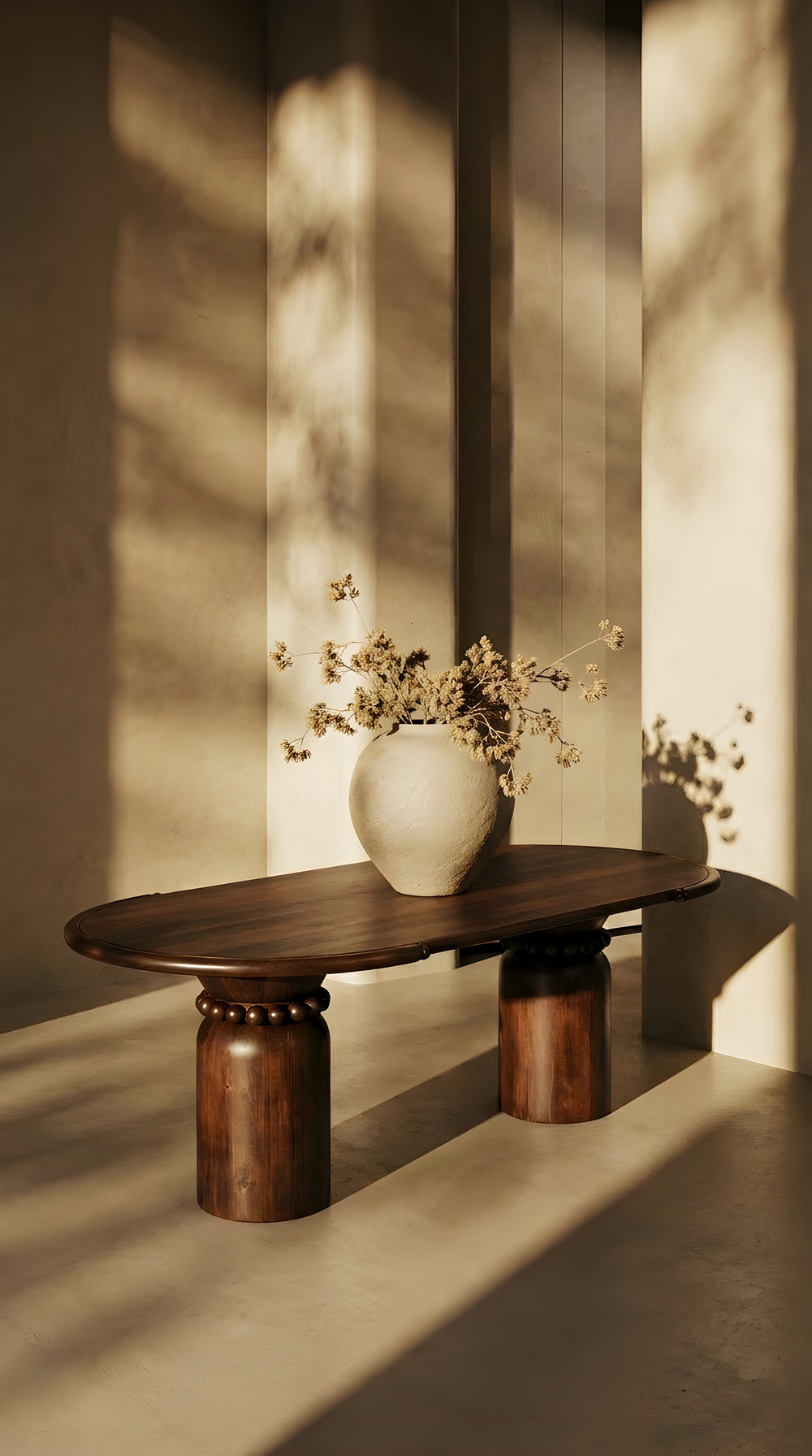
This is where art direction does most of the work. Art direction decides how pieces are staged, how light falls on the material, whether images are warm or cool, whether people appear, whether the frame is tight on a detail or wide on the room. Those decisions, repeated over hundreds of images, are what make a brand recognisable at a glance. If your brand cannot be identified from a cropped image with the logo removed, the design language is not doing its job.
 Huba Concept. See the project
Anchor the identity in values and a true story
Values and heritage give an identity depth. For an established house, the heritage is real and should be used: the founding, the family or the workshop, the archive of pieces. For a younger brand, the equivalent is the founding story: why the brand exists, what the founders were dissatisfied with, what they refused to compromise on. Either way, the brand story has to be true and specific. A vague "passion for design" is not a story.
Define the tone of voice
Premium furniture brands often neglect language. The images are exceptional and the copy reads like a mid-market catalogue. Tone of voice is part of the identity. A refined, sophisticated brand should sound refined and sophisticated, which usually means fewer adjectives, not more. The brands with the strongest voice describe the object precisely and let the reader supply the emotion.
Materials, craftsmanship and the visual proof of premium
Branding cannot invent quality, but it has to make quality visible. Premium furniture is built from quality materials, solid wood, leather, stone, metal and hand-finished textiles, with careful craftsmanship and quality control. None of that is obvious from a small product image on a white background.
The brand's job is to turn material and craftsmanship into evidence:
- macro photography of the grain, the stitching and the joinery;
- video of the workshop and of the hands doing the handcrafted work;
- content that explains why a wood was chosen, where the leather comes from and how sourcing works;
- a consistent way of showing finishes, so customers learn to read them.
This is where many premium furniture brands fail. They describe materials in a specification sheet and hope the customer infers the value. The customer does not. The brand has to show it, repeatedly and in the same visual language, until the association between the name and exceptional materials becomes automatic.
Understanding the market segment for luxury furniture
Branding decisions depend on who the brand is for, and the luxury furniture market is more fragmented than it looks. Each segment reads the brand differently.
| Segment | What they look for | What the brand must show |
|---|---|---|
| Private residential clients | An emotional promise of luxury living | Atmosphere, lifestyle imagery, timeless design |
| Interior designers and architects | Rigour and design credibility | Detail, finishes, technical information, projects |
| Hospitality and residential developers | Durability and delivery at scale | Quality control, references, contract capability |
| Retail partners and dealers | A brand that sells itself | Strong assets, clear guidelines, consistent imagery |
A premium furniture brand does not need a different identity for each segment, but it needs one flexible enough to speak to all of them. The usual answer is to keep the core design language constant and vary the emphasis: a residential campaign leads with atmosphere, a contract catalogue leads with detail and specification. Decide early which type of business you want to be, primarily residential or primarily contract, because it shapes everything from the range to the tone of the website.
The professional audience is international. The 2025 edition of Salone del Mobile.Milano recorded 302,548 attendances, 68% of them from abroad, with 2,103 exhibitors, according to the organiser's closing press release of April 2025. A brand that wants to be specified by designers from many countries needs an identity that reads clearly without translation.
The key features a premium furniture brand must communicate
From the customer's point of view, the key features of premium furniture are well known: quality and craftsmanship, timeless design that will not date, comfort and functionality, an elegant and refined aesthetic, often innovation in materials or form, and a sense of exclusivity.
The branding has to communicate each of these without listing them. That is the difference between telling and showing:
- Timeless design is shown by placing an older piece next to a new one and letting the continuity speak.
- Comfort is shown by photography of the piece in use, slightly lived in, rather than perfectly staged.
- Innovation is shown by explaining one technical detail in depth rather than claiming innovation in general.
- Exclusivity is shown through restraint: fewer, better images and a selective distribution.
A useful exercise is to list the features the brand wants to own, then audit the last fifty images and the last twenty pieces of content and ask which features are actually visible. Usually one or two dominate and the others are missing. Rebalance the identity accordingly.
How to market a luxury furniture brand without cheapening it
Furniture marketing for premium brands is a balance between visibility and restraint. Every marketing decision either reinforces visual authority or erodes it.
The strongest brands market through content and context rather than promotion. Their websites work as editorial platforms: projects, designer profiles, articles on materials, explorations of style. Their social media shows spaces, not sales. Their advertising appears where their audience already looks, in architecture and design media and in the right showrooms and cities.
Three rules hold across the category:
- Avoid public discounting. Once a premium piece is regularly on sale, the price becomes negotiable in the customer's mind.
- Control the imagery everywhere. Dealers, marketplaces and retail partners should use the brand's own photography and follow its art direction, or the design language fragments.
- Invest in the physical experience. Showrooms, trade fairs and events with designers and architects remain the most powerful way for people to meet the material.
Strategy matters more than tactics. A brand that follows trends looks like a brand that follows trends. A brand with a clear strategy, a defined target audience and a consistent visual identity can ignore much of what the furniture industry does each season. If you are also building a studio or interiors business, our article on branding for interior design studios covers the service side of the same market.
Design inspiration and the brand as a filter
Founders often ask where the best furniture design inspiration comes from. Inspiration is rarely the problem: interior design, contemporary art, architecture, fashion and travel are inexhaustible sources. The problem is filtering. A premium furniture brand cannot explore every creative direction it discovers. It has to keep the ones that belong to its design language and reject the rest, however tempting.
This is where branding and product design meet. The identity should act as a filter for the collection. If a new piece does not fit, either the piece is wrong or the identity needs to evolve deliberately rather than drift. The strongest houses can work with many international designers and still produce a coherent collection because their own aesthetic is strong enough to absorb them. Style is a brand decision before it is a design decision.
The essential pieces that carry the brand
Every luxury furniture brand has hero pieces: the sofa, the dining table, the lounge chair, the bed that defines the collection. They appear in every campaign, anchor the showroom and become the icon people associate with the name.
Choosing them is a branding decision. The hero piece should embody the positioning as fully as possible. A brand built around leather craftsmanship leads with the armchair that shows the leather best; a brand built around solid wood leads with the dining table. Lighting, storage, rugs, outdoor furniture and accessories can extend the range, but a brand is usually remembered for two or three pieces, and the identity should be built around them.
How we approach it
At Stevenson & Co, we treat branding for a premium furniture brand as a system to be managed over years, not a launch. Our approach follows five steps.
- Audit what already exists. We gather every image, page, catalogue and dealer listing and look at them side by side. Inconsistencies are usually obvious within minutes.
- Write the positioning in one sentence. If that sentence could describe another maker, we start again.
- Define the design language. Light, framing, palette, typography, staging and tone are written down as rules, with examples of what is and is not on brand.
- Produce the core assets. Art direction and shoots for the hero pieces, material close-ups, and project imagery that shows the pieces in context.
- Roll out and measure. Guidelines for partners and dealers, then tracking of branded search, organic traffic, enquiries from designers and engagement, so that every decision can be judged on results.
The mistakes we see most often are always the same. Borrowed identity: a brand that looks like a successful house and therefore like a hundred others. Inconsistency across channels: a refined website next to a chaotic Instagram and poor dealer photography. Over-explaining: product pages that list every award and certification, which is mid-market behaviour. And neglect: treating branding as a launch task, when the brands with the most authority refine the same identity for decades. Our guide to what makes a luxury brand identity different goes further into these codes.
Branding as the foundation of visual authority
Visual authority for a premium furniture brand is built the way the furniture is: from good materials, with discipline, over time. It rests on a clear positioning, a design language applied without exception, imagery that turns craftsmanship into evidence and a tone that trusts the customer to recognise quality without being told. The brands that dominate the market have no secret beyond this; they have simply done it consistently for longer.
You can see how we work with interiors, hospitality and lifestyle founders on our lifestyle and wellness brands agency page.
At Stevenson & Co, this is the work we do with our clients: giving premium furniture brands the visual authority their craftsmanship deserves, from positioning and design language to art direction across every channel. We work with founders in Paris, Dubai, Amsterdam and New York who know that in premium furniture, the brand is what turns an exceptional piece into a price the market accepts. If that is where your brand is heading, get in touch with us.
Frequently asked questions
What makes a furniture brand premium rather than simply expensive?
Premium combines material quality, craftsmanship, design integrity and brand coherence, while expensive is only a price. A premium furniture brand justifies its price through visible evidence of quality and an identity that makes the price feel consistent with everything else the customer sees.
How do you create a strong furniture brand identity?
Start with a positioning more specific than quality and craftsmanship, then translate it into a design language: rules for light, framing, palette, typography, staging and tone. Anchor it in a true founding story and apply it without exception, from the website to dealer listings and trade fair stands.
How do you market a luxury furniture brand?
Favour content and context over promotion: projects, designer collaborations, material stories and spaces rather than sales. Avoid public discounting, control how partners and dealers show your pieces, and invest in physical encounters such as showrooms, trade fairs and events with designers and architects.
How long does it take to build brand authority for a luxury furniture brand?
Years rather than months. The identity itself can be defined in a few months, but authority comes from applying it consistently across collections, campaigns, showrooms and content until the market recognises the brand instantly.
Should a premium furniture brand work with well-known designers?
It can help, but only if the brand's own identity is strong enough to remain the protagonist. A weak brand that hires famous designers becomes a showcase for the designers rather than a brand in its own right.